New Analytical Methods for Graphical Knowledge Extraction
Virtual Museums
This website is under continuous development.
Analytical Instruments
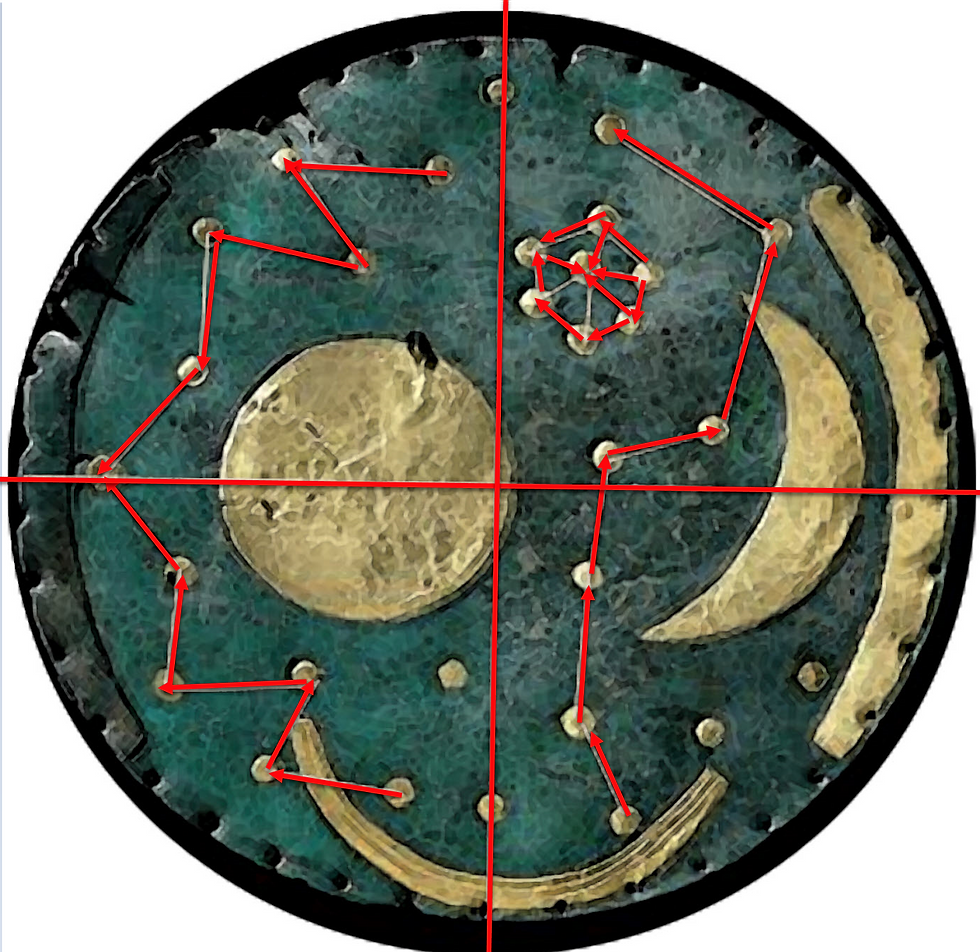
Ancient Calendear or a mythological world map? This approach is exemplified by the iconocartographic reading of the Nebra Sky Disc, in which structural image analysis precedes any symbolic decoding. A cartographic mode of enquiry is thus initiated: only through differentiated perceptual registration are the preconditions for informed interpretation established.
In practical terms, this entails a sequence of analytical operations, including:
Axis analysis: Are symmetry axes or directional vectors discernible?
Zones of visual density: Where do colour values or structural elements concentrate?
Centre–periphery dynamics: How is visual attention distributed across the image field?
Contrast mapping: Where do ruptures, transitions, or visual boundaries emerge?
Pathway systems: Can trajectories of movement or gaze be identified within the image?
Communicative reinforcement: To what extent can cartographic devices (for example, hillshading) enhance or intensify the intended communicative effect? Are there similarities wich can be confirmed by using procrustes tests?
It is always a matter of achieving an appropriate balance between iconographic and cartographic analysis. In our view, this balance is attained when the results are as valid and objectively verifiable as possible.
1. Theoretical Foundations and Context
In How Maps Work, Alan MacEachren emphasises the heuristic value of Gestalt theory in cartography: proximity, similarity, and continuity structure visual perception. Figure–ground relations and Prägnanz underpin clarity and communicative effectiveness. Iconocartography extends these ideas into an integrative framework for visual analysis.
Form—whether two- or three-dimensional—carries legible traces of intention. Artistic perception and cartographic analysis are linked through the act of depiction (gráphein). Communication unfolds within the triad of intention – form – statement, with meaning emerging through form.
This perspective aligns with reflections by Emanuela Casti. An early application by Wirth (2002) showed that the Altamira cave paintings form coherent compositions rather than isolated figures, reshaping interpretations of prehistoric cognition.
2. Theoretical and Epistemological Foundations of the Dresden School of Cartography
The Dresden School of Cartography has advanced the view of maps as communicative sign systems, strengthening cartosemiotic approaches. Maps are understood not as neutral representations but as structured fields of meaning.
Developments such as 3D and autostereoscopic techniques at the Technische Universität Dresden expand cartographic language and support more intuitive spatial understanding. Building on Jordan, scholars like Manfred Buchroithner and Emanuela Casti highlight how visual variables—colour, line, symbol—shape interpretation.
From an epistemological standpoint, Buchroithner frames maps as constructions shaped by perception, cognition, and culture. Map reading is therefore inherently interpretative. Empirical studies also reveal perceptual limits when engaging with complex visual structures.
Overall, this leads to a perception-oriented cartography: maps are not merely representations but products of active meaning-making—an idea exemplified in true-3D cartography.
3.Artanalytical Aspects
Within art-historical and art-educational discourse, the “language of drawing” and the adequate analytical description of visual artefacts have long been contested. Iconocartography refines the tradition of immanent analysis by approaching visual objects—whether images, maps, or hybrids—with systematic, descriptive rigour and minimal presupposition. Its primary aim is to document and examine the visual structure, spatial organisation, and functional dynamics of an artefact prior to any semantic or symbolic interpretation.